

May 20, 2026

Reinstallation of the Historical-Folklore Museum of Corinth
May 28, 2026
AIΘRA
June 16, 2026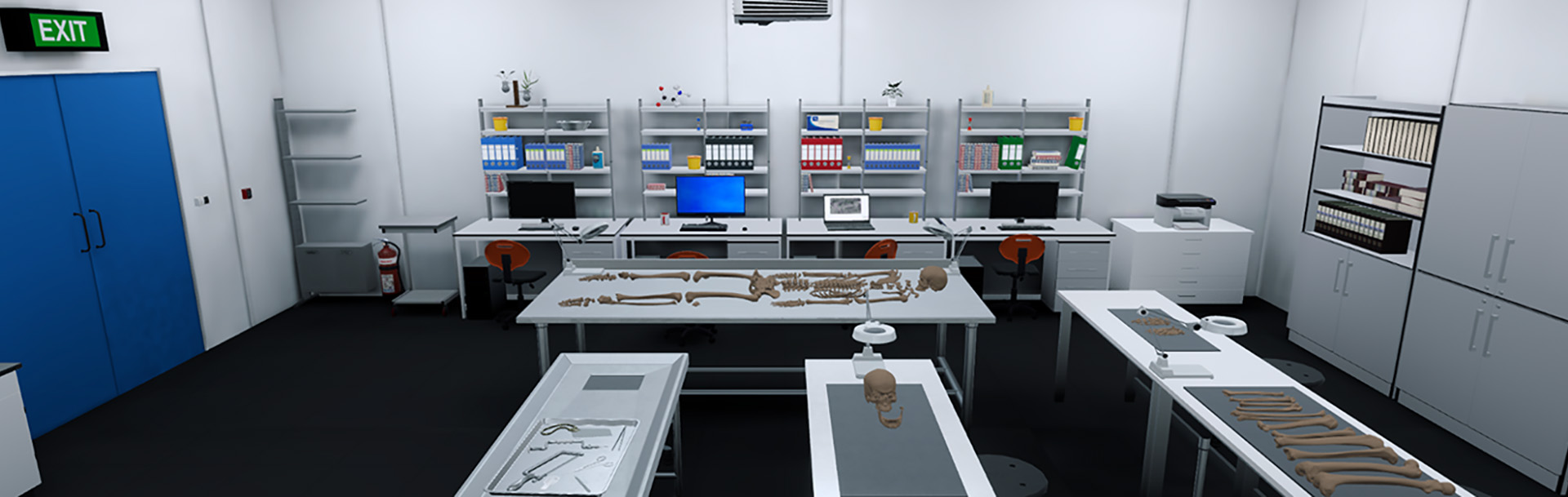
The “Virtual Laboratories of Evolutionary Medicine” project was developed in 2026 for the Laboratory of Biological Anthropology at Democritus University of Thrace. The project involved the creation of three immersive virtual laboratories dedicated to Evolutionary Medicine: an Osteology Laboratory, a Histology Laboratory, and a Stable Isotopes Laboratory. Through Virtual Reality (VR) technologies, real laboratory spaces, scientific equipment, and research procedures were transformed into a fully interactive digital learning environment.
The application was developed for Windows and integrated with Meta Quest VR headsets, providing a simulation-based educational experience available in both Greek and English. Users can enter the virtual laboratories, interact with scientific equipment using natural hand movements, and perform laboratory procedures step by step, closely replicating real-world laboratory workflows.
The project's objective is to provide a modern educational platform that supports safe hands-on training, interactive learning, and remote access to specialized laboratory experiences.
The “Virtual Laboratories of Evolutionary Medicine” will be integrated into the newly established Interinstitutional Master of Science Program “Evolutionary Medicine” developed by the Laboratory of Biological Anthropology of the School of Humanities at Democritus University of Thrace, in collaboration with the Institute of Evolutionary Medicine of the University of Zurich.
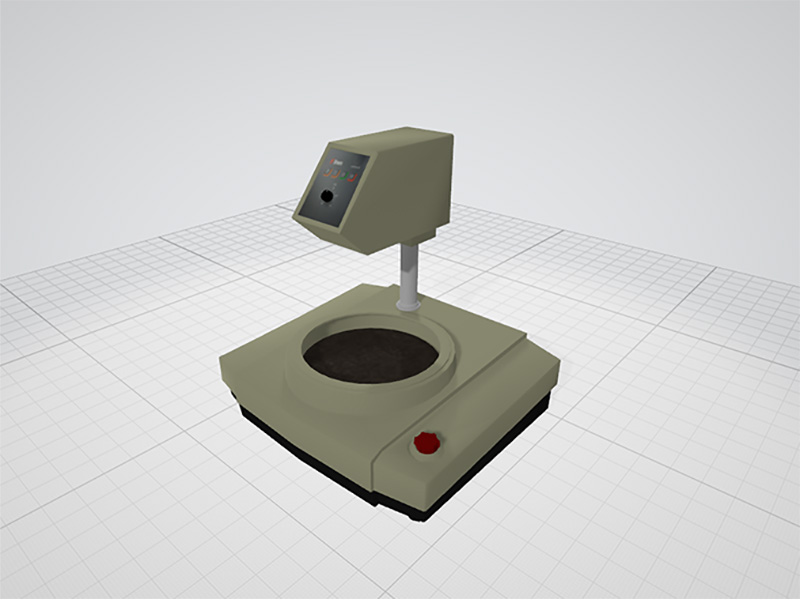
The development of the virtual laboratories began with the complete digitization of the Laboratory of Biological Anthropology's facilities and scientific equipment. Using high-precision 3D scanning technologies, detailed digital models of laboratory instruments, biological specimens (including bones and teeth), and workspaces were created while preserving their real-world geometry and morphology.
The resulting data were processed and optimized for virtual reality environments, enabling the rendering of highly detailed photorealistic models while ensuring smooth performance on VR devices.
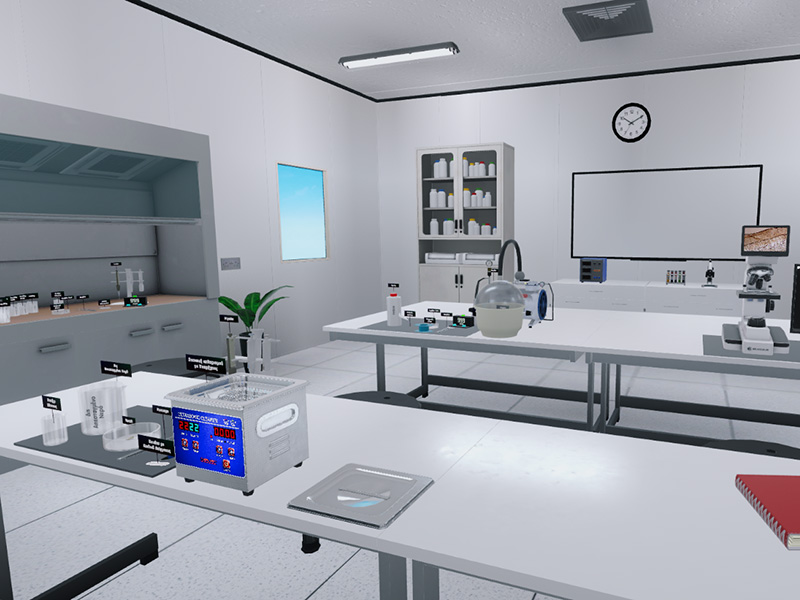
Based on the digitized assets, three digital twins were developed, accurately replicating the Osteology, Histology, and Stable Isotopes laboratories. Users can freely navigate the environment, operate scientific instruments, and perform laboratory procedures through natural interactions.
Using hand-tracking technology, users can carry out tasks such as handling samples, operating measuring instruments, adjusting laboratory equipment, and monitoring experimental results in real time. This approach provides learners with valuable practical experience in a safe and controlled environment, free from the limitations associated with physical equipment availability and access to specialized laboratory facilities.
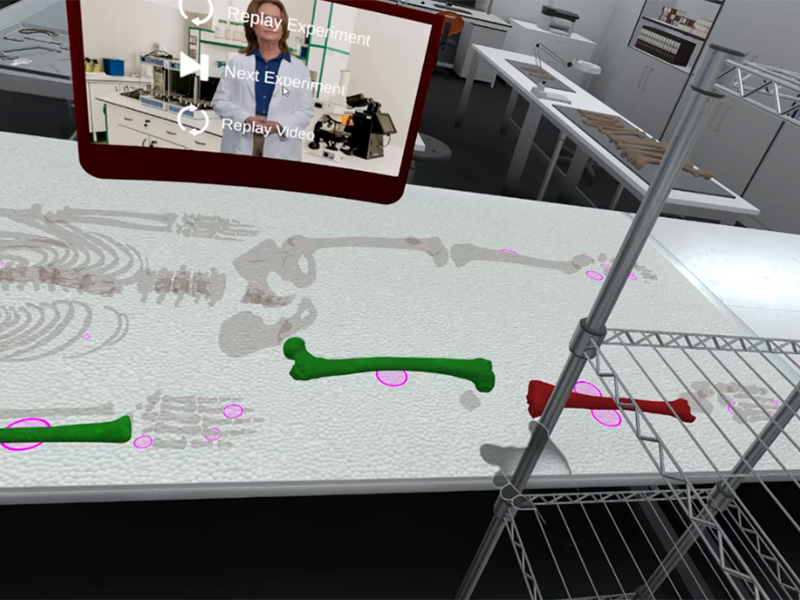
The learning experience is built around interactive scenarios that replicate real scientific and laboratory procedures, helping users understand both theoretical concepts and their practical application.
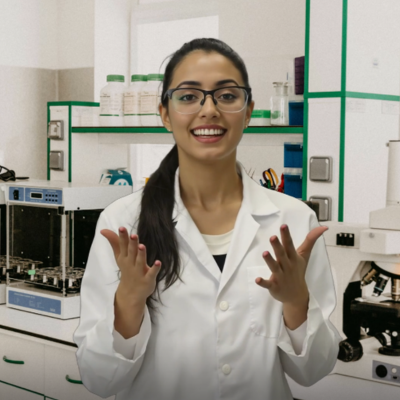
Each scenario begins with an audiovisual introduction delivered by a virtual avatar, which explains the objectives of the procedure and guides users through each step. Participants are then required to actively perform the necessary actions within an immersive environment featuring realistic simulations and laboratory tools.
Throughout all scenarios, users receive immediate feedback on the accuracy and sequence of their actions. Gamification elements, including audiovisual feedback mechanisms, progress indicators, and interactive learning features, are integrated into the experience to enhance engagement, reinforce knowledge acquisition, and support effective learning outcomes.
Αυτός ο ιστότοπος χρησιμοποιεί cookies
Χρησιμοποιούμε cookies για να εξατομικεύουμε το περιεχόμενο και τις διαφημίσεις, να παρέχουμε λειτουργίες κοινωνικών δικτύων και να αναλύουμε την επισκεψιμότητά μας. Επίσης, κοινοποιούμε πληροφορίες σχετικά με τη χρήση του ιστότοπού μας από εσάς στους συνεργάτες μας στα μέσα κοινωνικής δικτύωσης, στη διαφήμιση και στην ανάλυση δεδομένων, οι οποίοι ενδέχεται να τις συνδυάσουν με άλλες πληροφορίες που τους έχετε παράσχει ή που έχουν συλλέξει από τη χρήση των υπηρεσιών τους.
Τα cookies είναι μικρά αρχεία κειμένου που μπορούν να χρησιμοποιηθούν από ιστοσελίδες για να κάνουν την εμπειρία του χρήστη πιο αποδοτική.
Η νομοθεσία ορίζει ότι μπορούμε να αποθηκεύουμε cookies στη συσκευή σας μόνο εάν είναι απολύτως απαραίτητα για τη λειτουργία αυτού του ιστότοπου. Για όλους τους υπόλοιπους τύπους cookies χρειαζόμαστε τη συγκατάθεσή σας. Αυτό σημαίνει ότι τα cookies που κατηγοριοποιούνται ως απαραίτητα επεξεργάζονται βάσει του άρθρου 6 (1) (στ) του GDPR. Όλα τα υπόλοιπα cookies, δηλαδή αυτά των κατηγοριών προτιμήσεων και μάρκετινγκ, επεξεργάζονται βάσει του άρθρου 6 (1) (α) του GDPR.
Αυτός ο ιστότοπος χρησιμοποιεί διαφορετικούς τύπους cookies. Ορισμένα cookies τοποθετούνται από υπηρεσίες τρίτων που εμφανίζονται στις σελίδες μας.
Μπορείτε ανά πάσα στιγμή να αλλάξετε ή να ανακαλέσετε τη συγκατάθεσή σας από τη Δήλωση Cookies στον ιστότοπό μας.
Μάθετε περισσότερα για το ποιοι είμαστε, πώς μπορείτε να επικοινωνήσετε μαζί μας και πώς επεξεργαζόμαστε τα προσωπικά δεδομένα στην Πολιτική Απορρήτου μας.
Παρακαλούμε αναφέρετε το αναγνωριστικό συγκατάθεσής σας και την ημερομηνία όταν επικοινωνείτε μαζί μας σχετικά με τη συγκατάθεσή σας.

